What We Learned Building an AI Agent That Can Say “I’m Not Sure”
Most AI systems are engineered to produce an answer rather than admit uncertainty. This works fine for many applications, but not for video editing. When an AI video editor makes a confident wrong call about which frames to cut or where to blur sensitive data, that mistake ships directly to your audience. Building demo video automation means treating uncertainty as a legitimate output instead of forcing the model to choose between wrong answers. This shift improves privacy protection, reduces editing errors, and accelerates workflow by letting humans make informed decisions on edge cases.
The Confidence Problem in AI Video Editing
Why AI defaults to certainty
Machine learning models are incentivized to produce outputs and be right more often than wrong. This works for photo categorization or churn prediction, but video editing is different. An AI video editor faces thousands of micro-decisions per recording: Is this blur sufficient to hide the API key? Should this scene cut here or three frames later? Traditional AI assumes sufficient training data eliminates uncertainty. It doesn’t, it just hides uncertainty behind high confidence scores.
The risk of false positives in automated editing
When an AI video editor makes a wrong call, consequences cascade. A misidentified sensitive region means unredacted customer data. A cut placed one frame too early creates jarring continuity. A missed zoom point leaves viewers confused. Unlike a chatbot that can hedge language or a recommendation engine where wrong suggestions carry minimal cost, video editing mistakes are visible and permanent once they ship.
When an AI Video Editor Should Admit It Doesn’t Know
Privacy detection: the highest-stakes uncertainty
Blurring sensitive data is where false confidence becomes a liability. An AI model trained to detect credit card numbers, API keys, and email addresses will catch obvious cases. But context-dependent secrets, a customer’s internal project name, a domain sensitive only within that company’s security policy, a Slack handle embedded in a screenshot, require knowledge the model doesn’t have. Why We Don’t Trust AI Redaction Alone explores this problem: relying solely on automated detection creates false confidence in security.
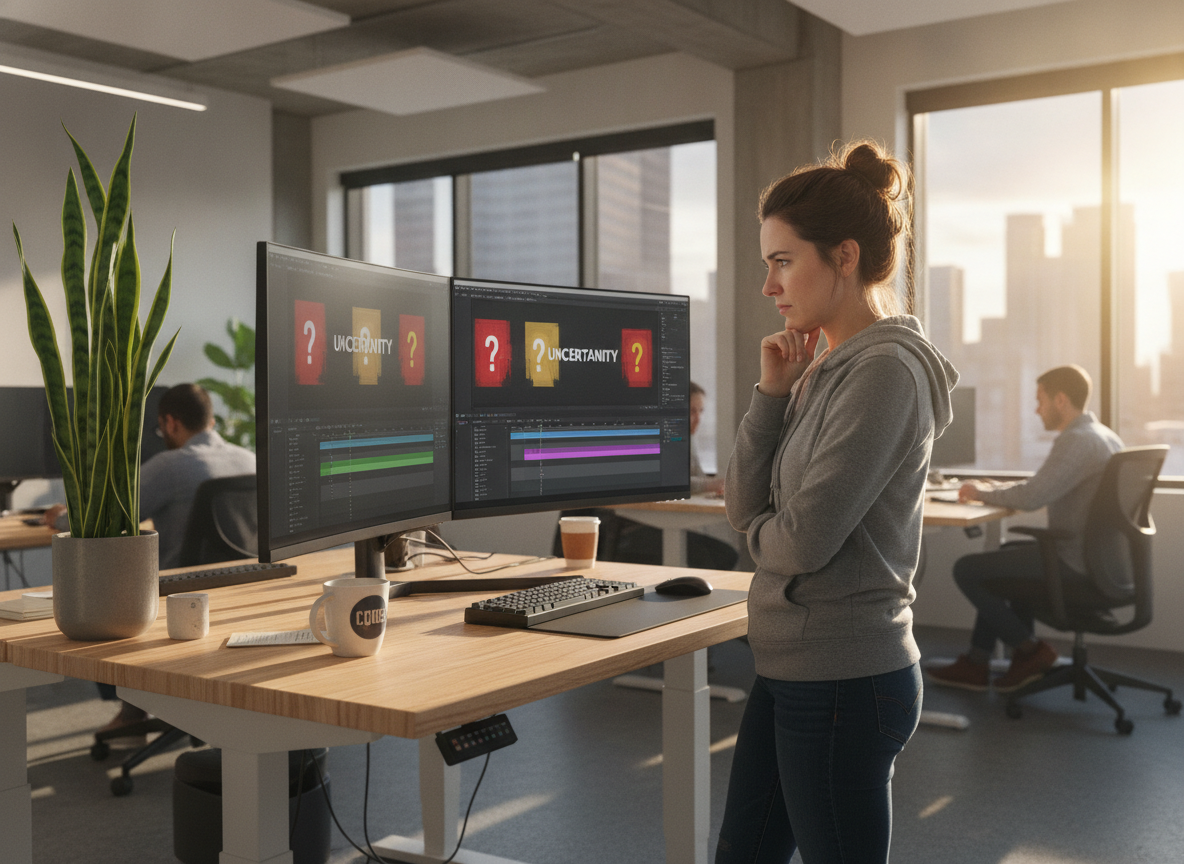
Photo by Quixess Social
The solution is flagging uncertainty rather than forcing a decision. When the redaction model encounters an edge case, surface it for human review instead of redacting everything or nothing. Let humans make the final privacy decision based on actual context.
Editing decisions with ambiguous context
Beyond privacy, many editing decisions have multiple valid answers depending on audience and intent. Where should a zoom focus? When should a cut happen? A smarter approach flags these moments and lets the editor decide based on knowledge of the audience and message.
How Uncertainty Becomes a Feature, Not a Bug
Designing the review workflow
Traditional AI video editing treats the model’s output as finished product. Users hit render and discover problems only after publishing. A better approach makes uncertainty visible before rendering. Surface the reasoning behind each edit, scene detection confidence scores, transitions flagged as ambiguous, and moments where multiple interpretations were possible. Users see an edit plan before the final video exists. When the AI encounters ambiguity, it flags it, shows options, and waits for approval. Users catch mistakes before shipping, which is critical for sensitive data or customer-facing demos.

Building trust through transparency
Transparency doesn’t slow teams down, it accelerates them. When users understand why the AI made each decision, they develop intuition for what the tool handles well and where they need to intervene. A system that shows its work creates a feedback loop. Users approve edit plans in minutes rather than re-recording entire videos. Teams ship faster because rework disappears. The solution doesn’t promise perfection; it promises visibility and control.
The Product Advantage of Honest AI
Why AI video editors need human oversight
A product demo builder that flags edge cases ships faster than one trying to handle everything. Teams prefer seeing what the AI flagged over discovering problems after publishing. The moment a video reaches an audience with blurred mistakes, missed cuts, or exposed credentials, trust breaks. Systems that admit uncertainty create checkpoints that prevent these disasters.

Photo by Quixess Social
Moving faster by knowing your limits
Uncertainty architecture scales better as you add features. When designed to flag edge cases rather than hide them, adding new video formats, longer recordings, or more complex workflows creates visible flags users can understand and address. Teams using AI tools with explicit confidence signals report fewer post-publication edits and lower support burden related to output quality.
Conclusion
AI systems optimized for shipping polished output without human review create risk. Building an AI agent that says “I’m not sure” requires rethinking the workflow, not just the model. The most reliable automation includes checkpoints for human judgment, especially around privacy and accuracy. Demand transparency from your tools. The team that knows when their AI is uncertain will outship the team relying on black-box confidence every time.
